
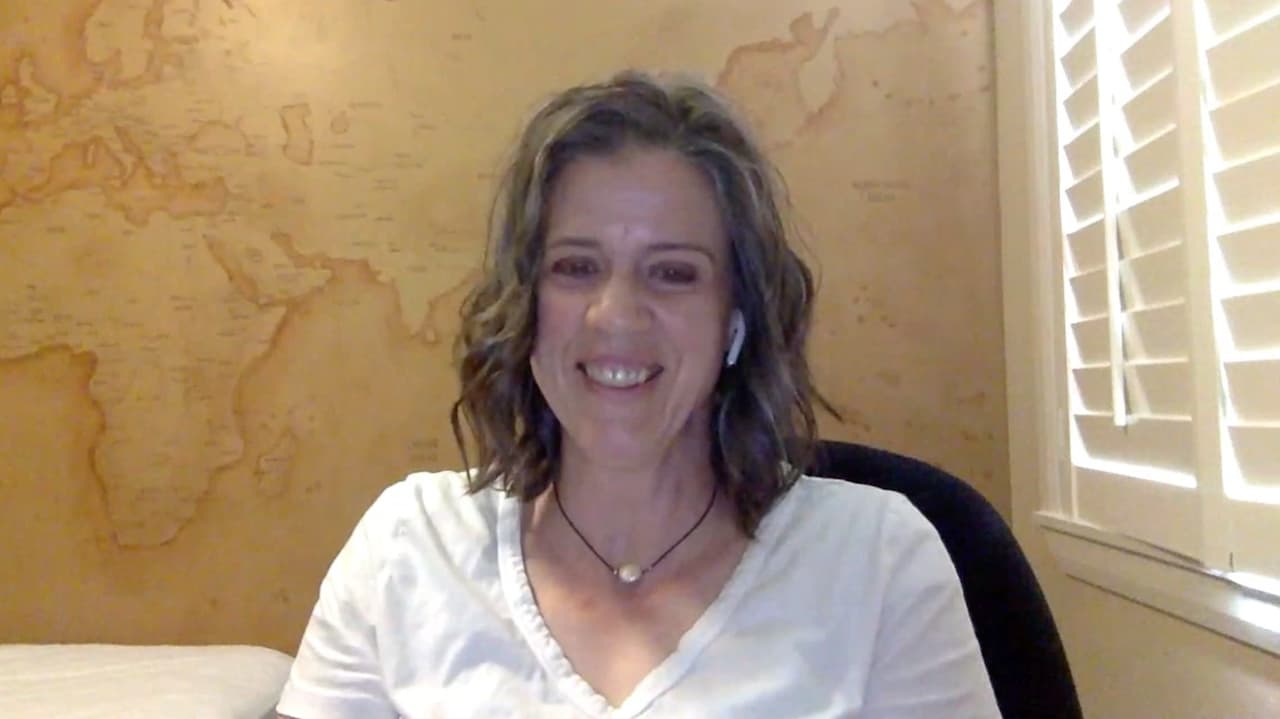
Amber had always been someone people counted on. A nurse. A mom.
For most of her life, sleep wasn’t something she worried about. It just happened. Then life changed.
After her second baby — who arrived early and had some health problems — nights became more difficult. She’d lie down only to wait for the next cry. It felt easier to stay awake than to sleep.
Years working as a NICU nurse added another layer. More responsibility. More pressure to perform. Sleep felt increasingly fragile and one night she couldn’t sleep at all. Panic showed up. Heart racing. Mind spinning.
Insomnia became something to fix.
She researched. Tightened her routine. Optimized sleep hygiene. Tried teas. Tried prescriptions. Got in and out of bed. Tried relaxing harder. Tried doing everything “right.” Nothing worked.
In fact, the harder she tried, the more she struggled. Nights became lonely and exhausting. Life started to revolve around sleep.
Then, in the middle of the night, searching for help, she stumbled across stories of people who weren’t fixing sleep — they were changing how they responded to being awake. Less fighting. More flexibility. More focus on living.
It wasn’t quick. It wasn’t perfect. But little by little, Amber’s struggle loosened.
And sleep stopped being the boss.
Subscribe: Apple Podcasts | Spotify | Amazon Music | iHeartRadio | Podchaser | TuneIn
Transcript
Martin: Welcome to the Insomnia Coach Podcast. My name is Martin Reed. I believe that by changing how we respond to insomnia and all the difficult thoughts and feelings that come with it, we can move away from struggling with insomnia and toward living the life we want to live.
Martin: The content of this podcast is provided for informational and educational purposes only. It is not medical advice and is not intended to diagnose, treat, cure, or prevent any disease, disorder, or medical condition. It should never replace any advice given to you by your physician or any other licensed healthcare provider. Insomnia Coach LLC offers coaching services only and does not provide therapy, counseling, medical advice, or medical treatment. The statements and opinions expressed by guests are their own and are not necessarily endorsed by Insomnia Coach LLC. All content is provided “as is” and without warranties, either express or implied.
Martin: Okay. So Amber, thank you so much for taking the time out for your day to come onto the podcast.
Amber: Thank you.
Martin: Let’s start right at the very beginning, as always. Can you tell us when your issues with sleep first began and what you think might have caused those initial issues with sleep?
Amber: Yeah. For the most part I’ve been a pretty good sleeper.
Amber: However, I’ve had some points in my life where it’s become a little bit hard and I would say the first time that I noticed a significant change was that was after I had my second baby, he was early, he had some health problems. And I noticed, that I started losing my sleep then. Obviously every new mother does anyways, but I was worried about feeding him.
Amber: I was worried about him getting enough to eat. I would get him settled and then I would lay down and just be waiting for that next cry. And so it was like almost easier to stay awake in a way, but not in the long run. So that was the first time I noticed it. And then the bulk of my career I have been a NICU nurse, which also made me a little anxious about my newborns.
Amber: Sometimes I would be a little bit anxious before certain shifts. Not always, ’cause I worked for 25 years and it was great. But occasionally I would be anxious about getting to bed and in time and getting enough sleep. And so I noticed it there. And then I went back to school a few years ago to become a nurse practitioner and I probably had a little bit of a harder time sleeping during school.
Amber: I got a lot more sensitive to my husband’s snoring during that time and, very light sleeper. And then after that, when I got my first job as a nurse practitioner, I was very on edge and very anxious. And while I was orienting for that job, I did not get a lot of sleep. I still at that time wasn’t paying a lot of attention to the sleep itself.
Amber: Just aware that I wasn’t sleeping enough. Then I would say a couple years ago is where it really came to a head. I had various just normal life stresses going on with various kids and things. And one night I just could not sleep. And I started to recognize that I was having a bit of panic attack and I had some experience with panic and anxiety in the past, like mainly around that baby that I told you about.
Amber: I had learned to work through that and I really hadn’t experienced a lot of it for probably a good decade and a half, but I noticed it that night and that generated a real fear response to me. And I thought, I remember distinctly having thought, oh my gosh, is this gonna keep me from sleeping now? And that’s, that was the hallmark.
Amber: That’s what started it. And it became its own beast from that point on.
Martin: You can recall a lot of times in your life when there were some stressors going on, for want of a better word, and that impacted your sleep. But it tended to be the case that once those initial triggers were no longer present or as relevant, things tended to get back on track.
Amber: I had experienced times in the past where my anxiety was higher and I have always known that my personality goes a little in that direction, but it was manageable. I had been able to manage it and I had learned to manage it pretty well previous to that.
Amber: But this time it I think the fear that it was going to affect my sleep, I did not know how to deal with that, and that scared me on a whole new level. And so now I feel like I was dealing with two things, just, being an anxious sort and now not being able to sleep on top of that.
Amber: I value my health and I work in healthcare and so I do pay attention to details for sure.
Amber: And getting enough sleep was very important to me. I know all the health benefits of that I’ve, and so the thought of not being able to have that and trying to function without it was quite terrifying to me, especially thinking of taking care of other people’s health.
Martin: So you’ve got that added pressure to perform sleep because it’s not just about you, it’s also about all the other people you’re interacting with and caring for each day. What were you doing to try and get things back on track?
Amber: I just go right to trying to problem solve. And of course that’s an important part of my job. That’s how I’ve dealt with being a mother and any other role I’ve had is to figure out, okay, what do I need to do differently?
Amber: I need to understand this better. I’m gonna research it. I’m going to read about it. I’m gonna see what other people do and I’m gonna try all those things just, and I’m gonna, I’m gonna fix this. That’s what I thought. I’m gonna fix it. And so I did several different things. A lot of things that I’ve heard described on your other episodes.
Amber: Sleep hygiene was a big thing, and that is actually something I talked to patients about. And so I thought I need to make my sleep hygiene better and I need to make sure I get in bed at a certain time and have everyone be quiet. I can’t have my noise in my room. I need to be really relaxed, so I’ve got to force myself to be relaxed.
Amber: Try some of the sleep herbal teas. I don’t love medication, so I was trying not to go there in the beginning. Eventually I did go and try some medication. I have plenty of nurse practitioner friends that could write me a prescription for something. And so I tried various things, but only briefly I will say I, because I quickly realized that there was no medication that was helping.
Amber: It might help initially. And then very quickly I discovered that my alarm system was stronger than the medication. And I think I tried maybe two or three different things and I just thought, I’m not gonna do this anymore. ’cause I don’t really wanna be on it anyways and it’s not helping. So yeah, I tried all those things.
Amber: It was a difficult time.
Amber: There was one night where I tried Ambien. I had tried hydroxyzine, I had tried Trazodone. Those two didn’t help at all.
Amber: And one night I tried Ambien and I knew as a professional that’s not a medication that you want to take for very long ’cause it can really be disrupted to sleep. But by that point I was so desperate that I thought maybe if I took it a couple nights, it would help reset me. And that was even the term that the provider I talked to and I had was that maybe I needed a couple nights of reset.
Amber: And I, so the first night I tried it and I was really relieved knowing that I had it that night. So I think my anxiety went down quite a bit right there. ’cause I knew I had something that was going to help and I just slept like a log that night. And so I thought, great this is it. I’m gonna do this a couple nights, I’m gonna get rid of it and I’m gonna move on and be normal again.
Amber: And the very next night I took it and I slept really hard for maybe two hours and then I was up the rest of the night and I was pretty blown away that I had overpowered that medication that I knew to be pretty strong. And so from, I just threw it out at that point because I thought this isn’t working and it’s not gonna, it’s gonna, give me side effects anyway, so I don’t want it.
Amber: So yeah I was really to the end of my rope at that point. I didn’t know what else to do.
Martin: I think a lot of people will identify with at least some kind of aspect of your experience with the medication there. You’ve got that thing and it can feel like a sense of relief.
Martin: It’s almost like you’re delegating all of the effort that you might felt you had to put into sleep to try and make it happen, now it’s not your issue anymore, it’s down to whatever this thing is. So you take it and it’s that’s it. Now there’s no more effort. There’s no more trying, there’s no more pressure, there’s no more performance anxiety, and that in itself can just immediately create better conditions for sleep.
Martin: Maybe the real issue is all the understandable trying and the pressure and the effort.
Amber: Yeah that’s very true. And as you were talking, I actually was thinking of something else I tried. I had an another provider tell me to at night it was a CBT thing. It was to get out of bed when I started feeling those anxious feelings so that I wouldn’t associate my bed with that anxiety.
Amber: And I thought that makes sense ’cause I’m really struggling when I’m laying in my bed. And she told me also to pull out the Old Testament and read Leviticus ’cause it’s really boring. And maybe that would help. And I did it and it was boring. But I found after a while it, it helped a bit initially, but I found after a while that the exercise of getting in and out of bed when I was feeling anxiety was adding to my anxiety.
Amber: ’cause I was just like, oh, here I go again. I’ve, been in bed for 15 minutes. I gotta get out again. It was just something else I had to keep track of.
Martin: Did it almost feel like an additional punishment on top of being awake, this kind of obligation that I should be getting out of bed as well?
Amber: Yes, it did. Very much yeah, it was not relaxing to me.
Martin: I’ve had guests on the podcast that have found it really helpful to get out of bed during the night, and I have other guests just like yourself that did not find it helpful to get out of bed during the night.
Martin: And I think really it just comes down to what our intent is. If we are getting out of bed because we are trying to get rid of anxiety or thoughts or feelings or to get rid of insomnia, to make ourselves feel sleepy again, to make sleep happen, then we might be setting ourselves up for some struggle if our experience tells us that’s out of our control if we’re getting out of bed, just because to us, that feels like a more productive way of spending our time awake during the night.
Martin: Maybe that is gonna be helpful for you. And if your goal is to just use that time awake in a way that’s more useful, that involves less struggling, we can then see that it doesn’t matter, does it? You can do that in bed. You can do that out of bed. Because our goal is just to experience this with less struggle.
Martin: It’s the struggle that kind of adds all that extra difficulty on top.
Amber: That is very true. And that is what I had to come to. It took me a while. And I know I actually emailed you a few times about, I wanted you to tell me exactly what to do and of course you won’t do that.
Amber: Your answers are to help people search themselves to find out what they need to do because it is very individual. And I finally came to. I just need to see how I feel in the moment. If it feels better, if I want to stay in bed, then I’m gonna do that. But if the feelings of, I don’t know, anxiety or restlessness, get too much for me and I would rather do something out of my bed, then I’ll do that.
Amber: So I really ended up not having a certain way of doing things, which I think was a key.
Martin: You were giving yourself more flexibility. Whereas when we were in problem solving mode, it’s I have to do this, I have to do this, I have to do this. And they’ve got this long list, haven’t we?
Amber: Yeah, the algorithm.
Martin: Exactly. Yeah. But then when we start to ease up a little bit, don’t cling onto it quite so tightly, we can become a little bit more flexible. And that in itself can be quite freeing, right? Because
Amber: it is
Martin: now we realize we’ve got options again, and that just opens things up a little bit.
Martin: That doesn’t mean that things are just immediately gonna change, but it can just relieve some of that weight from our shoulders and help us realize that we can choose what we want to do.
Amber: It’s quite liberating actually, when you get to that point.
Martin: Just to rewind a little bit, what was an average night like for you back then, if there was such a thing?
Amber: In the beginning, just sheer difficulty. It was miserable. It was absolutely miserable. I felt very isolated and very alone because of course everyone else in my house is completely out sleeping beautifully. And I am not.
Amber: And it seemed to me like everybody in the neighborhood was sleeping great too. And I am up pacing and walking the hallways or trying to, focus on something that I can’t focus on. Having a lot of an anxious feelings. It just was awful. And then dreading the next day when I was going to be exhausted and very certain I wasn’t going to be able to perform in any of my roles the way I wanted to.
Amber: That was the beginning. As time went on, that very slowly improved, but I did still have a lot of difficult nights as I moved forward.
Martin: How was this influencing your days when you were still tangled up in the struggle?
Amber: Yeah, that was really hard. I called in sick the next day at work and I hardly ever call in sick. I think I’ve missed, gosh, two days and two and a half years. I really, but I didn’t think I could be capable of my job the next day, and I was terrified of myself and terrified of how I would let down other people.
Amber: And so I stayed home and just continued to suffer at home. And then, I mentioned my job a lot. That’s a really important role to me. But of my most important role is that of mother. And as family member to my family. And I also felt like I was not able to do a good job there. I felt like I was not quite present.
Amber: They could tell that I just wasn’t as happy or didn’t have the energy. I wasn’t doing things that I enjoyed as much. It was just really became enclosed in myself and an obsessed about how I could fix this problem, not a good way to live.
Martin: It makes sense why you called in sick to work not only for yourself, for your own wellbeing. It felt what if I might make a mistake at work because I can’t really focus. I’m so distracted. So it’s completely understandable why you would do that. And then at the same time, when you call in sick, you’re not doing that career or that job that might feel important to you.
Martin: That’s reflection of who you are. It’s all this stuff influences your actions in a way that you get pulled away from that life you want to live. And that could be your work, your home life, your family life, your identity. It just feels like your actions start to serve insomnia, sleep, all these thoughts and feelings rather than your actions serving you, who you are and the life you want to live.
Martin: And that just makes it all so much more difficult.
Amber: Yeah, that’s so true. It’s like insomnia became the boss.
Amber: I wasn’t new to the sensation of anxiety or panic. I had episodes of that in the past and I was feeling pretty confident that I knew how to handle that. ’cause it had been so long and I had moved through some really difficult things in my life.
Amber: And I did okay. So then this thing came along and it was mysterious because I’d had this confidence so I could handle anxiety and difficult things. But this was a whole new thing and it caused me to go right down to the bottom again and go, what is wrong with me? What is wrong with my brain?
Amber: Why I felt like I wasn’t doing it to myself, but I couldn’t understand how or why I was doing it to myself. So yes, very mysterious and very difficult for me to understand in the beginning.
Martin: When you came across my work, what made you think that there was something different or something new or opened up this possibility that there’s a new way forward here?
Amber: As probably most people that encounter your work it was in the middle of the night while I was on, looking for help in the middle of the night because I was just desperate. And I stumbled upon some of your, maybe one of your YouTubes, I think, and you were interviewing somebody like this.
Amber: I listened to the person’s story and I thought, oh my gosh, that sounds exactly like how I feel right now. They were really expressing how desperate they were in the beginning and how confusing all the feelings I was feeling at the time. And so that really grabbed my attention because I heard the same level of desperation in this person’s description of themself, and yet they were now being interviewed by you and having worked through that.
Amber: And so it gave me hope. And as I listened to it more, I realized that it actually was very similar to how I had learned to manage anxious thoughts or anxiety in the past. And that was to let them happen. So it was a different level of learning how to let something happen. So that cognitive understanding started coming.
Amber: The more I would listen to your things on YouTube and your podcasts, I had, I felt like it made sense. It resonated with me.
Martin: This is why I’m just so grateful that people like yourself are willing to come on because it, it can be so powerful to hear these journeys and these stories.
Martin: There’s that validation. There’s the acknowledgement that you’re not alone, and then there’s that hope, and you had the bonus of being familiar with an approach of opening up to insomnia, opening up to panic, fear, anxiety.
Amber: It’s a paradoxical thing that, that is how you get through it is by actually allowing it to happen.
Amber: So that, that was a pivotal moment for me and started my process of recovery, which certainly didn’t happen overnight. But the cognitive understanding was there.
Martin: So in terms of allowing it to happen, in a practical sense, how do you allow insomnia, for example, to happen when you really don’t want it to happen.
Martin: How do you allow anxiety to happen when you really don’t want it to happen? What does that look like in, in terms of practical action?
Amber: Yeah. That that, that was the next big hurdle was trying to figure that out. I asked that question of myself and of you, I think several times again, and it’s not something that you can figure out overnight.
Amber: It takes a lot of practice. I think ongoing practice, I don’t think that practice ever ends because there’s always a new layer of things.
Amber: One of them was to not beat myself up for things, because I realized that when I would get really frustrated and go, why can’t I do this? Why can’t I? What’s, why do I think this?
Amber: Why is my brain so busy? Why do I think I have to problem solve everything? Why? I realized that I was just throwing fuel on the fire. I was just putting more pressure on myself. Friend said to me one morning, something that stuck with me, and you actually repeated in an email something very similar.
Amber: She said I would never change your problem solving mind. It makes you who you are and look at all the things you’ve been able to do and accomplish. Because of the way your mind works and who would you be without your mind the way you were? And you had said something pretty similar to me about that too.
Amber: So from that point on, I started looking at that differently and not flogging myself for just being who I am and seeing the benefit of the way my brain works. That was a big realization for me. And then another one was to realize when I was starting to try to prob over problem solve, maybe, oh, it worked this night but this didn’t work that night.
Amber: Maybe I did it a little bit wrong. Maybe you know, I’m not following the algorithm. It was frustrating ’cause professionally, I really do have to follow algorithms a lot. And so I was having to pull away from that natural way of thinking. And not get stuck in this loop of problem solving and just letting it be, not worrying about it so much.
Martin: Step one perhaps was, not beating yourself up over something that your own experience is telling you is out of your control. If you could have made a certain amount or type of sleep happen, you would’ve, you’d be doing it, right? If you could magically and permanently delete anxiety from your mind, you would’ve done it.
Martin: But your experience tells you that’s not possible. You tried and tried. The conclusion from your experience was that’s not possible. So it sounds like part of your journey towards opening up a little bit more to this difficult stuff that you’d rather not experience is to acknowledge that it is out of your control and that your mind isn’t working against you, it’s not your adversary, even though it can sometimes feel that way.
Martin: Because anxiety generally speaking doesn’t feel good. We can see it as a negative thing or a bad thing. If only this anxiety will go away, I would be able to sleep. If only this anxiety would go away, I would be able to be the person I want to be.
Martin: But the brain generates anxiety because it’s trying to give us information about something. It’s trying to remind us of something that’s important. It’s trying to protect us. It’s trying to look out for us. It’s trying to keep us safe, and it’s gonna do this whether there’s a real threat or not, because it’s hyper cautious.
Martin: It’s focused on doom and gloom. ’cause all the good, happy, fluffy, safe stuff isn’t a threat or a concern. So the brain spends no time on that. It’s only ever gonna focus on what might happen or the worst possible outcome or the worst possible experience.
Martin: If we feel anxious that maybe we left the gas stove on. And so we turn around in our driveway and we go back in, we find out we did leave the gas stove on. Is anxiety still a bad thing when it stopped our house from exploding? It’s like what we add on top of it that is the source of so much of our struggle.
Amber: Yes, very true. I think, I started using an analogy in my head as I was figuring this out more as a NICU nurse, which.
Amber: All those years, if you’ve ever been in, in a neonatal intensive care, there’s a lot of alarms that go off all the time. And so sometimes the nurses get a sense of whether it’s an alarm that needs to be paid attention to or not. And people who haven’t been in there are really on edge because they can just, why are we not getting on top of all these alarms, but the nurses like this one, this is okay.
Amber: We’re okay. We don’t need to do anything about it. And I started to realize that’s what was probably going on in me is I, I had an alarm that had some value to it and at times I needed to, of course I need to attend to it. I don’t wanna not be fearful of anything. But it also can go off for things that are not really urgent or really emergent.
Amber: It might be a mistake, it might be like in the nicu, maybe the baby’s wiggling and setting off their alarm, and it’s not a problem. So realizing that a little more was helpful to me.
Martin: I think that’s a fantastic analogy and I love how you connected it to a real ongoing experience that’s relevant to your life.
Martin: ‘Cause that always makes this stuff so much more powerful. And yeah, there’s, these alarms are going off. Sometimes they’re helpful, sometimes they’re useful, sometimes they’re less helpful, sometimes they’re not helpful, they’re not useful. Sometimes maybe they’re more of a distraction than anything else, but what are they?
Martin: At the end of the day, they’re snippets of information and we get to decide how to respond. The alternative approach if you’re in that ward is to just be so focused on, I must not hear any alarms today. I can’t hear any alarms. That’s first of all, that’s just gonna take so much of your energy, focus and attention.
Martin: How are you gonna be able to care for your patients and do the stuff that matters when your brain is, all of its capacity is on trying to avoid hearing an alarm.
Amber: And as time went on, I think my alarm system got a little smarter. I wasn’t going off as much because it wasn’t bothering me as much.
Amber: One other thing that’s come to me while we’ve been talking that I also realized I had a few different epiphanies while going through this, and I realized, I kept realizing different levels at which I was trying to force something to happen. Initially it was trying to force sleep.
Amber: Then it was trying to force myself to relax and not have anxiety. And then when I started doing your program and going about it that way, then I was trying to force myself to be okay or maybe even being awake or be okay with the anxiety. And I wasn’t. And it took me a while to realize, oh, I don’t have to like this actually, I can acknowledge this is hard.
Amber: It is not. This is not ideal. This is not what I wanna do. This is not how I wanna feel. And that’s okay. But I can make a choice here. I do have a choice in what I’m gonna do next. I can have a choice in my discernment. And that was probably one of the bigger epiphanies that I had. ’cause that one really carried out over into other parts of my life too.
Martin: I’m glad you made that point because when we hear about this idea of reducing our resistance to something that we don’t really want to experience or to accept it, this whole philosophy of acceptance, a common reservation I guess that people have is but I’m not okay with this. How do I make myself be okay with something that I’m not okay with?
Martin: I want to be asleep. I don’t want to be awake. And that’s where we can get tripped up. Because it’s not about pretending that you are okay with it. It’s not about pretending that you enjoy being awake pretending that fatigue doesn’t exist, pretending that anxiety doesn’t make things more difficult, that you enjoy it, that it’s great to experience.
Martin: It’s about accepting that this stuff is gonna show up and it’s trying to fight it or avoid it just makes things more difficult. And it’s about, just as you touched upon, bringing your focus back to how you choose to respond to it when it shows up. Choosing to respond in a workable way, a way that isn’t going to layer on all these extra pieces of difficulty and struggle on top of it when it shows up. So I’m really glad you mentioned that because I think that is important.
Amber: Yeah. Yeah. I think that is important. I think that’s a really common misconception when someone starts back on this journey, whether it’s insomnia or trying to deal with anxiety, is then trying to figure out how am I supposed to be okay and enjoying this? And you really can’t, that’s not, that’s really not what we’re trying to do here.
Amber: It’s okay to acknowledge that it’s hard.
Martin: It might even be essential to acknowledge that it’s hard and that in itself might be part of opening up to it.
Amber: Yeah. Agreed.
Amber: I have memory of when I was young, when as a child and I’d get the stomach flu and I had to throw up. It was just a horrible thing. I did not wanna throw up. I would fight it, and my mom would come with me to the toilet, she would hold my head up and she would just rub my back.
Amber: And she would keep saying, just let it come. Just let it come. And I trusted her, and I would let it come, and I would let you know, have the release, and then I would feel better. And it’s more like that to me now. It’s I can let this happen. It doesn’t feel good right now. Might even feel worse before it’s done, but it’s not gonna stay this way.
Amber: I know that now. So that’s a different thing. And then instead of getting really frustrated with my busy brains that likes to think about everything and figure out everything. Now it’s more oh, let’s just see what’s on, what’s on TV tonight? What’s on the brain tonight?
Amber: I’m more like, wow, look at my busy brain. Isn’t that amazing? It can bounce back and forth. To this, that and the other. And it goes fast. Sometimes it’s a little fast for me, but I’m actually more grateful for it now ’cause it helps me keep track of a lot of things and stay on top of a lot of things.
Amber: So I look at that differently as well.
Amber: Another big learning point is what what I can control and what I cannot, and to, there are a lot of things we cannot control and to try to control them, escape from them, or numb yourself to them, distract yourself, it just adds to something that might already be difficult.
Amber: So letting those things be, and then finding where I can control, which is my actions, my response I went into, when I started this out, I did try some meditation, but my understanding of meditation has changed so much in the beginning. I was trying to force myself to relax. I was trying to make my really naturally busy brain not think of anything, and it just doesn’t happen.
Amber: And so that would become more and more frustrating to me. It was just a frustrating experience. I thought I’m never gonna get this down. Now. I choose to relax. I can relax my muscles and my body and I can let myself breathe. But it, you mentioned the word intent or motive in the beginning. My intent of my motive is different.
Amber: It’s not to force total relaxation and calm and quiet my brain and not have thoughts. Now it’s, I am relaxing myself to allow them, if that makes sense. And it has been that has been a real game changer for me as well, because I realize the more I do that, oh, actually, I. I don’t really feel that anxious anymore.
Amber: It’s just gotten better and better. It doesn’t mean I don’t have anxiety, but I’ve, I have a very different approach now and it feels so doable to me compared to the way it used to feel.
Martin: Would you say it’s almost like you are practicing and building skill in experiencing, I’m just gonna say anxiety ’cause that’s the last one that you mentioned.
Martin: Experiencing anxiety with less struggle. So it’s showing up, but it’s losing the more you practice experiencing it with less resistance, it’s almost like it starts to lose its power and influence. So it still shows up, but it’s not as strong, it’s not as distracting. It’s not got that power it once maybe held over you.
Amber: That’s exactly what’s happening now. The thing if I, if for example, if I go to bed and I’m worried about one of my kids or a patient I saw, and it’s leaving me with this unrest inside. I, now we’ll just realize, okay, I’m going into one of these loops where I’m thinking about this a lot, worrying about it all.
Amber: The worry in the world is not gonna change it. I’m gonna just name I’m feeling this way because this is going on, or this is happening and I’m just gonna allow it to happen. I’m gonna relax and allow it to happen. I can maybe think of some more solutions tomorrow, or I can check in on the thing. I just start coming up with things I can do.
Amber: To help it. And it really has it has more of a profound effect on me in helping me get through this.
Martin: Whilst you were talking, I was thinking back to that alarm analogy you were sharing, and I was thinking that maybe a brand new member of staff, maybe they’ve just finished their training and they’re in that ward for the first time, hearing all those alarms go off, it must be terrifying.
Martin: It feels like you’ve really thrown in the deep end, but then as you build up that experience of listening to those alarms going off nonstop choosing through experience on how you’re responding to each of one, each of them, the alarms are still going off, but they’re not having that huge effect on you, that huge physiological effect on you anymore.
Amber: Yeah, that’s exactly right. It’s very it’s very comparable to that experience.
Martin: How does this transfer to sleep then? So we’ve talked about opening up to the thoughts and the feelings. How does that get you to a place where you are not struggling with sleep anymore?
Amber: With sleep it’s really was the same thing.
Amber: The, I bring up anxiety a lot because I feel like the anxiety and the lack of sleep was just so intertwined with this experience. I did have to become more okay with being awake and that took time. And your direction on choosing values, value-based activities was very helpful to me because I’m very aware of what my values are and you know what things lead me more towards those and that type of life I wanna live and.
Amber: So I did go I went through a very sleepless period of time. I think there was one time where I felt like I didn’t get sleep for three nights in a row. Sometimes I don’t know that we’re totally aware of how much sleep we actually get, but that’s what it felt like to me. And I actually carried on.
Amber: I didn’t feel my best. Of course it wasn’t great, but I carried on very normally for those days and I was able to see, wow, I was able to accomplish, these things at work, at home. I had connection with people. I laughed with people. I had some good conversations. And so that was a big confidence builder to see that I actually really can do a lot without sleep.
Amber: It doesn’t feel, the way I like to feel, but I can do it. And so it took some of the fear out of that for me, and that was very helpful.
Martin: Maybe it comes down to exploring what we can do that might make this whole experience a little bit less difficult or a little bit less traumatic. It sounds like one way that you moved toward that goal was by committing to actions that reflected your values, living the kind of life you wanted to live, even when sleep wasn’t showing up.
Martin: And by doing that, I think a natural byproduct maybe, is that we do start to get a little bit more comfortable with being awake because it’s not having such a huge impact over our lives anymore. Even if it’s just a 10th of a percentage point better, we’ve got that 10th of a percentage point more control over our lives now.
Martin: It can snowball. So we become a little bit more comfortable with being awake. That’s not to say we want to be awake, but we just start to get a little bit more comfortable with it. We are less resistant to it. It’s not gonna pull us into quite so much of a struggle and in effect. That kind lowers it down on our list of priorities, perhaps for our problem solving brain.
Martin: Our brain’s oh, maybe we don’t have to fight this quite so hard. We don’t have to engage in this battle. And when we are not engaged in that battle conditions for sleep just become better because we’re not in the middle of a battleground at two o’clock in the morning. We’re awake. We’re experiencing all these thoughts and these feelings, but we’re not in a battleground anymore.
Amber: That’s absolutely correct. And since then, my attitude now I’ve had a couple of circumstances with maybe a teenage child that’s, been late for curfew coming home or maybe a medical issue with somebody that I need to help with. It’s late in tonight. And instead of thinking, oh my gosh, I’m not gonna get sleep now, I’m like, bring it. I can stay up and I can handle tomorrow. I’ve done it for three nights in a row.
Amber: I, it doesn’t scare me like it used to. So it’s a big shift in my perspective on that now.
Martin: That is a really big shift. I’m curious to know, as you were practicing this whole new approach that we’ve been talking about, did you find that progress was just it was kinda like this up upward curve where things just progressively got better and easier and less struggle.
Martin: Or was it more kind of ups and downs, or was it more just like someone had thrown a plate of spaghetti against the wall and it was just all over the place? What was it like for you?
Amber: I like the spaghetti analogy that it probably felt like that for a while. All over the place. I keep using the term cognitive understanding because in my head I could understand what you were saying or what I was hearing from other people.
Amber: It made sense to me. It resonated and I knew this was the way to do it, but anything else I’ve had to learn, whether it is becoming a nurse or a nurse practitioner or I used to run a lot of marathons, learning the best way to do that. Learning it in the book can make absolute sense.
Amber: And you think you’ve got it, but then actually putting it into reality and doing it experientially is an entirely different thing. And that does not come as quickly and it takes a lot of practice. And that’s exactly what happened with this. It took a lot of practice and I had a lot of ups and downs. I have a plate of spaghetti.
Martin: Yeah. And like when you’re learning any new skill there’s gonna be times when it maybe things feel easy, that you’re making great progress, you’re ahead of schedule, and then there’s gonna be times where it feels like nothing is working. You’re doomed to failure, you’re beyond help that you need to go back down that rabbit hole of looking for some something else to do instead.
Martin: I love the fact that you drew in your experience, in marathon running in your own career, the skills, achievements, they take a lot of practice, they take a lot of action, they take a commitment to action, and they also come with ups and downs, and they also come with all those thoughts and feelings that I just gave a few examples of, this isn’t working. We should give in.
Martin: If we think of where we’re most skilled in life, that wasn’t just immediately given to us, we had to earn it, and we earned it through committed action. Even if it’s just doing a little bit every day, it all adds up. It’s just continuing to do things that move us in the direction that we want to be heading.
Amber: Absolutely. And I do think when you start making that initial improvement, so when I first started to improve and I had a few good nights of sleep and I thought, oh, this is it. I’ve arrived. I figured it out. And then you have your first whatever you wanna call it, set bump, or, barrier in the road and you have another bad night.
Amber: It can be really deflating. ’cause you thought, oh, I figured this out and now this isn’t working, and what did I do wrong? You start, you catch yourself going through all of the same rabbit hole again. And so it is, there is a lot of patients required with those setbacks, they are going to continue to happen.
Amber: And I heard. I don’t remember where I heard it, but I heard someone say that they those types of setbacks come up for a reason. It’s an opportunity to practice. It just means that you need to practice again. It’s not really a bad thing, it’s just an opportunity to refine a skill. And again, changing the way I looked at those, ’cause those were pretty, they’re pretty hard, those setbacks once you start on the road to recovery.
Martin: 100%. And especially like you said early on especially if you’re really early in your journey and maybe you string some good nights together, or you have a few days where you notice you’re not completely overwhelmed with all these thoughts and feelings and you can feel really confident and motivated, yes, this is working, I’m doing really well.
Martin: And it can be so deflating and difficult when the difficult stuff shows up again. And even when you are further along in your journey, there can be lots of ups and downs and it can feel like you’re, it’s almost like your brain is, whoa, you’re back to square one.
Martin: Everything you’ve been doing up to this point was a complete waste of time, waste of effort. The truth is that it’s just your brain looking out for you. Again, the truth is you’ve just had this experience of some difficult nights or some nights where less sleep happened or some nights of no sleep, or you’ve noticed those thoughts and feelings showing up and gaining a little bit more power.
Martin: That’s what’s happened. Anything else that you are getting from that is stuff that we are understandably adding on top because we still don’t want to experience it. But what matters is identifying this is a normal part of any journey and that it is about how we choose to respond. And that’s something that we always have power over.
Martin: We have the power over our choice of actions, and it’s easy to respond in the way we wanna respond. When things feel good, when things feel easy, it’s when things feel difficult, that it’s most important we respond in the way that reflects how we wanna respond, and that’s really what counts.
Martin: How long would you say it took for you to get to a point where insomnia and all the thoughts and the feelings that can show up with it and after it weren’t creating a struggle for you that you could do things that matter, live your life, do what’s important to you, independently off sleep, and even in the presence of uncomfortable, difficult thoughts and feelings.
Amber: I think it’s hard to put a specific number on that because in the journey, I feel like I, I would go to that for quite a while and then maybe have a little, regression or whatever, and then I would go back to that.
Amber: But I will say, I think over time those regressions would get further and further apart. And so maybe six to eight months is where I started feeling like I was settling in back into my more normal self, my more baseline self.
Martin: Yeah, that’s helpful because I think it’s a reminder that really what we’ve been talking about this whole time are skills. They’re action-based skills and skills. Take time to learn, to develop, to practice. There’s gonna be ups and downs, there’s gonna be setbacks. And that takes time. We all obviously want immediate results. We wanna be able to just deal with this right now.
Martin: If I could offer that to people, I would offer it. I’d be a trillionaire. But it doesn’t work that way. It’s not easy, it’s difficult, and it requires ongoing practice.
Amber: I can honestly say that even though there were times where I just feel like this really brought me to my knees I wouldn’t change it now because of the benefit I’ve gotten from it. I don’t think there, there’s things that I don’t think I could have learned in another way. I think it’s benefited how I’m able to help others and of course my values, my roles, my role as mother.
Amber: Professionally as nurse practitioner or family member or friend, the people in my life, those are really important to me. And so this outlook and this focus of what I can and cannot control and how to allow these things to move through, to just be able to move through them and not go down the rabbit hole has been really helpful.
Amber: I’m very empathetic towards people that are going through something similar and it doesn’t have to be insomnia because so many struggles go down this road, right? They don’t necessarily have to be insomnia. And of course professionally I hear a lot about these types of things. I’m in that type of a position, and so I do, I have a lot of empathy.
Amber: I understand how things feel how difficult thoughts and feelings can fill, and I can give better guidance and direction. I can do that for my children and other people in my life.
Martin: It can be really hard to think of any positive aspects to this struggle when you are in the midst of it. It can almost sound disrespectful to think that there could be a growth opportunity, or it could have somehow have any positive impact on our lives. But a common theme that runs through so many of these podcast episodes is this sense of growth that can only come from that journey that has been experienced.
Amber: I mentioned how when I have had setbacks with insomnia or anxiety, I can see it more as an opportunity to practice. And so now when other things occur in my life that are difficult I think I can go to that maybe a little more quicker now because of that experience that here’s another opportunity.
Amber: This is happening. How can I go about handling it? What can I control, what can I not? And let myself move through it. And then I would say even just day to day, I think I take more I have more gratitude for things too, because. I’m not struggling with the battle and the calv calvary, as you mentioned.
Amber: Now I have more awareness of things around me that are important to me, or even small things like, good weather or flower. It does, it opens your eyes to other things.
Martin: These are transferable skills.
Martin: They don’t exist only for insomnia, only for anxiety. They can enrich or enhance your life in so many other ways, and that’s where you can end up coming out ahead. So like you shared, maybe now you’re finding yourself better at practicing gratitude. You find yourself better able to focus on values-based action.
Martin: Maybe you’re getting more from life because your values have just become more front and center. And so you’re ensuring that your actions reflect who you are, who you want to be and your, you focus, the focus of your attention is expanded. So maybe you are able to savor a few more of those moments that we might once have been on autopilot and missed out on.
Martin: If someone with chronic insomnia is listening. And they feel as though they’ve tried everything. They’re beyond help. They’ll never be able to stop struggling with insomnia.
Martin: What would you say to them?
Amber: Yes, I’ve anticipated that question and that’s really the reason I did this. I was a little reluctant in saying yes, but because this helped me so much, I couldn’t say no to you. Because this is doable. Even though you may be at the point where you feel like you’re completely broken, you’re completely alone.
Amber: No one understands. I’ve tried, A through Z, it’s not working. It is doable. It’s not gonna happen overnight. But it will happen. And it’s the key things that we’ve been talking about. It’s practicing, it’s being patient with yourself in the process. It’s being kind with yourself in the process.
Amber: It’s identifying what you have control over and what you do not. And, practicing those things over and over is really what will help this settle down. It’s very doable.
Martin: Great. Thank you again, Amber, for coming on. It’s just been a pleasure listening to you describe your journey and your transformation. So thank you.
Amber: Thank you.
Martin: Thanks for listening to the Insomnia Coach Podcast. If you’re ready to get your life back from insomnia, I would love to help. You can learn more about the sleep coaching programs I offer at Insomnia Coach — and, if you have any questions, you can email me.
Martin: I hope you enjoyed this episode of the Insomnia Coach Podcast. I’m Martin Reed, and as always, I’d like to leave you with this important reminder — you are not alone and you can sleep.
I want you to be the next insomnia success story I share! If you're ready to stop struggling with sleep and get your life back from insomnia, you can start my insomnia coaching course at insomniacoach.com.
Please share this episode!
)